
The Glass Key
Hammett’s alternative Noir city
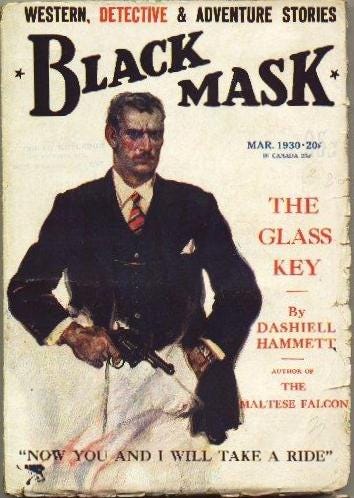
Adaptations of the novels by the father of the hard-boiled crime genre, Dashiell Hammett, helped to establish the parameters of Film Noir in the 1940s. The Maltese Falcon is generally accepted as a key influence on the genre. I would add The Glass Key to that list as well. It went past the shady but justice-bent character of Sam Spade to present a Noir protagonist who is an actual criminal whose pursuit of the truth is not always on the narrow path of justice. The Glass Key helped create space for moral ambiguity in Film Noir.
Hammett’s novel takes place in an unnamed small city which is run by a crime boss Paul Madvig. His right hand man, Ned Beaumont, a gambler, finds the body of a Senator’s son and is tasked by Madvig to ensure that the local District Attorney is not able to get to the bottom of the crime. His boss is backing the Senator in his re-election. This plan unravels as a rival crime lord threatens to pin the crime on Madvig and gang war breaks out. Beaumont takes a severe beating from Madvig’s underworld rival and his goons, as they try to get him to agree to turn on his boss, but he holds out and eventually escapes.
Undeterred, Beaumont works to solve the crime, as any Hammett protagonist would. Unlike Sam Spade, however, Beaumont is no knight-in-dented-armor and he winds up seducing several women, including one whose husband commits suicide over the affair and the Senator’s daughter, who is also seeing his boss. He’s deeply cynical, working to solve the crime not because of a sense of justice, but because so many people try and stop him and he can’t accept being told what to do. That’s a great quality in a protagonist, it provides a writer a character that is driven to complete whatever task they are set with, but also can screw things up for themselves by alienating people in their orbit and angering the wrong people.
Eventually Beaumont does solve the murder, clearing his boss, but completely wrecking their relationship. It’s not Beaumont’s fault, it’s due to the folly of Madvig, a tough from the streets, thinking he could push his way into elite society. They end the novel with Beaumont claiming the Senator’s daughter, leaving Madvig crushed.
Ned Beaumont said: “Janet is going away with me.”
Madvig’s lips parted. He looked dumbly at Ned Beaumont and as he looked the blood went out of his face again. When his face was quite bloodless he mumbled something of which only the word “luck” could be understood, turned clumsily around, went to the door, opened it, and went out, leaving it open behind him.
Janet Henry looked at Ned Beaumont. He stared fixedly at the door.
I really like the character of New Beaumont. He’s a cynic, but one grounded in common sense and experience. He’s loyal to his boss but isn’t afraid to let him know when he’s screwing up and winds up defying him as he pursues the truth. He’s not a muscle-bound tough guy but he hangs in there and prevails through brains and determination. I also like the fact that his cynicism extends to women and his willingness to say yes when offered the chance.
I read The Glass Key in the early 2000s, when I was writing my first novels, the Beatnik Spy series. I actually worked up a book idea involving a small city run by criminals. But more importantly, Ned Beaumont influenced the creation of my Beatnik Spy protagonist, Gunner Quinn. Quinn uses brains more often than brawn, but is stubborn and tough when he knows he’s right. And he never says no to a woman who wants to go to bed with him.
In the 1942 film adaptation, starring Alan Ladd as ‘Ed’ Beaumont and Veronica Lake as the Senator’s daughter, the story is jumbled up a bit but largely follows the original. Brian Donlevy plays Madvig and the terrific character actor Joseph Calleia appears as the rival mobster. Much of the film is a fairly standard crime drama/mystery and in my opinion, Ladd is a poor substitute for Bogey and Lake is “a fetching little trick,” as she was once referred to by a theater critic.
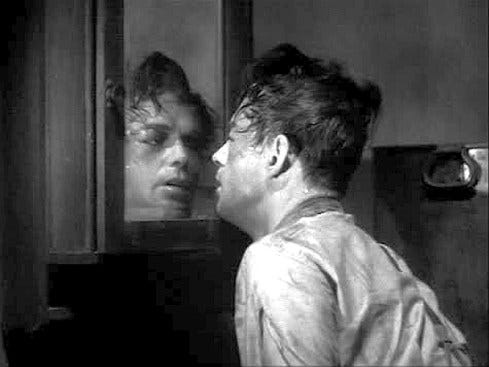
The sequence where Ladd is locked in a slum apartment and beaten brutally by Calleia’s enforcer, played with gorilla relish by William Bendix, does stand out. Ladd is literally beaten to a pulp, his face disfigured to resemble a monster from a horror film. The Production Code office originally vetoed approval of the script for this scene and others, citing “brutality” and “gruesomeness.” But the beating scene remained unchanged in the final version and it was only a later scene, where Bendix gleefully strangles Calleia that was ‘fixed.’ The Code Office insisted that a line be inserted for Ladd, who was looking on, warning Bendix to “Take it easy,” so as not to suggest that Beaumont wanted Bendix to kill his boss. Ladd delivers the line, but with such a cynical tone that it completely subverts its intent. The Glass Key did generate significant criticism on its release for its violence and was banned in a few markets.
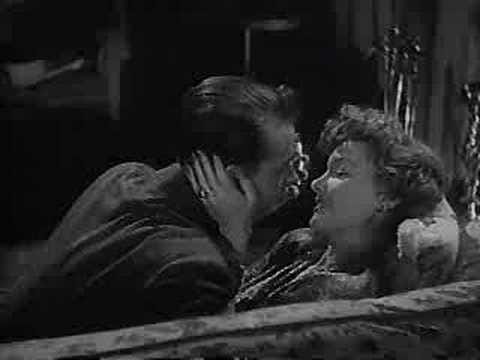
What the censors didn’t seem to have a problem with is one of my favorite moments in the film. Ladd is left alone with the wife of the newspaper publisher and they start making out – with her husband upstairs. Then we cut to the pair sprawled out on a couch together, all the lights down, when the wife says: “Shall we have another?” She’s referring to a drink but the double entendre is delicious.
The movie is enjoyable enough and I can see why the pairing of Ladd and Lake was so popular. She was probably the only actress in Hollywood that didn’t tower over him. The supporting actors are terrific, especially Bendix as the brutal Jeff. But it’s an adaptation of what is considered by many, me certainly, one of Hammett’s best works. I re-read it for this column and I relished all the hard-boiled text and dialog. I’d love to see it properly adapted again some day.