The Chaser
The roots of Obsession
The wildly unexpected box office success of Curry Barker’s Obsession was attributed to many factors: its commentary on modern dating dynamics and sexual morality, its creator’s YouTube base, or its place amid the wave of a horror film renaissance.
What nearly everyone has overlooked is it’s often adapted and successful source material: John Collier’s short story, The Chaser.
Collier is a largely forgotten or overlooked writer, in spite of the frequency of appearances in anthologies and adaptations in television shows. He specialized in elegantly written, ironic short stories with shocking or perverse endings. One critic labeled them”smiling misanthropy.” I love his work and have tried copying it, with mixed success.
His most famous story is likely The Chaser. A lovesick young man seeks a love potion to win over woman for whom he holds...an obsession. The vendor sells him the potion for one dollar, warning the young man that she will never want to leave his side and will center every minute of her life around him. In passing, he mentions that he also has a poison called The Glove Cleaner that is “colorless as water, almost tasteless, quite imperceptible.” This he sells for $5,000.
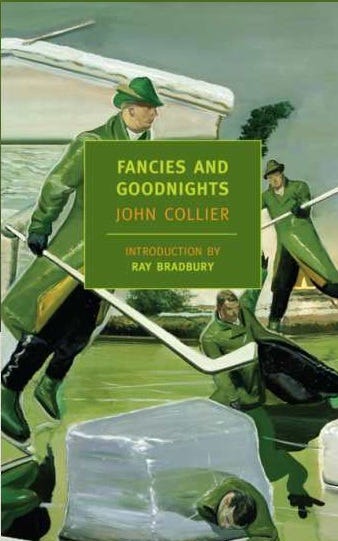
The Chaser first appeared in the December 21st issue of The New Yorker. After it appeared in his short story collection Fancies and Goodnights in 1951, it won the 1952 Edgar Award and the 1952 International Fantasy Award.
The Chaser is a crime story, but has most often been adapted as a horror story. As Obsession demonstrates masterfully, the impulse to make someone a slave to you is a horrific idea.
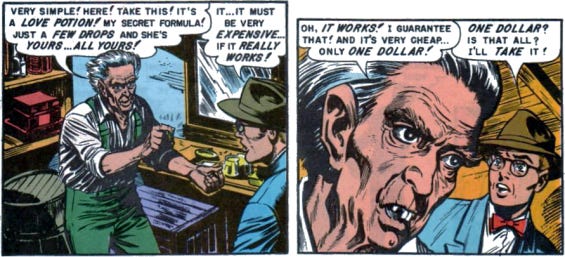
It was first adapted in the EC comic Tales From the Crypt #25, August-September, 1951, as “Loved to Death.” It was uncredited to Collier, which was not unusual for EC; they plagiarized several Ray Bradbury stories, but were called out by the author for it. He worked out arrangements to get paid and receive credit; EC benefited from his growing fame. He and Collier weren’t the only ones to receive that treatment. (I am planning on writing a post about the classic stories EC adapted or borrowed elements from, sometime in the future)
EC Comics portrayed the growing obsession of the wife and added its own twist ending, which was a requirement in those pages.
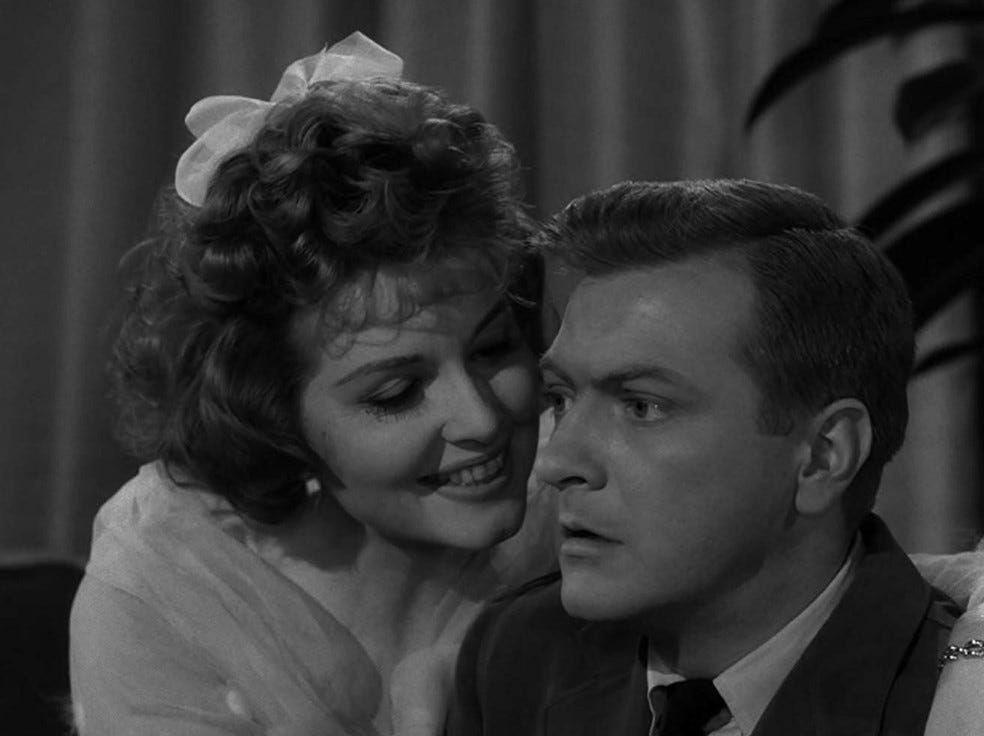
It was next adapted in 1960 by The Twilight Zone, fully credited and named “The Chaser.” It offers a comic take on the material, portraying the ideal domestic life between the young man and his victim that morphs into cloying suffocation. It adds an ironic end when, just as he is about to serve her The Glove Cleaner, she reveals she is pregnant.
HBO’s Tales From the Crypt series adapted the EC Comics version in 1991, with Andrew McCarthy and Mariel Hemmingway. This was an even more comic take, along with HBO standard boobs and sex. It followed the twist ending of the comics version, with a little added gruesomeness. Overall, I think it’s a step down from the Twilight Zone episode.
And Obsession? No credit for John Collier, no acknowledgment of the source of the idea that a magical item creates an overpowering attraction for its wielder in the heart of a target. If I was to guess, I would imagine that writer/director Barker recalled the idea from the Tales From the Crypt adaptation and unconsciously appropriated it.
Barker replaces a potion with a magical wish stick and the glove cleaner with an out that costs the user everything. I saw the ending coming, in part due to my familiarity with Collier’s original, and I am deeply respectful to Barker for pulling it off without hesitation. Great horror movies require great endings.
To help win John Collier the credit he is due, I offer the text of The Chaser herein, all rights reserved to his estate.
* * * * *
The Chaser, by John Collier
Alan Austen, as nervous as a kitten, went up certain dark and creaky stairs in the neighborhood of Pell Street, and peered about for a long time on the dime landing before he found the name he wanted written obscurely on one of the doors.
He pushed open this door, as he had been told to do, and found himself in a tiny room, which contained no furniture but a plain kitchen table, a rocking-chair, and an ordinary chair. On one of the dirty buff-colored walls were a couple of shelves, containing in all perhaps a dozen bottles and jars.
An old man sat in the rocking-chair, reading a newspaper. Alan, without a word, handed him the card he had been given. “Sit down, Mr. Austen,” said the old man very politely. “I am glad to make your acquaintance.”
“Is it true,” asked Alan, “that you have a certain mixture that has-er-quite extraordinary effects?”
“My dear sir,” replied the old man, “my stock in trade is not very large-I don’t deal in laxatives and teething mixtures-but such as it is, it is varied. I think nothing I sell has effects which could be precisely described as ordinary.”
“Well, the fact is...” began Alan.
“Here, for example, “interrupted the old man, reaching for a bottle from the shelf. “Here is a liquid as colorless as water, almost tasteless, quite imperceptible in coffee, wine, or any other beverage. It is also quite imperceptible to any known method of autopsy.”
“Do you mean it is a poison?” cried Alan, very much horrified.
“Call it a glove-cleaner if you like,” said the old man indifferently. “Maybe it will clean gloves. I have never tried. One might call it a life-cleaner. Lives need cleaning sometimes.”
“I want nothing of that sort,” said Alan.
“Probably it is just as well,” said the old man. “Do you know the price of this? For one teaspoonful, which is sufficient, I ask five thousand dollars. Never less. Not a penny less.”
“I hope all your mixtures are not as expensive,” said Alan apprehensively. \
“Oh dear, no,” said the old man. “It would be no good charging that sort of price for a love potion, for example. Young people who need a love potion very seldom have five thousand dollars. Otherwise they would not need a love potion.”
“I am glad to hear that,” said Alan.
“I look at it like this,” said the old man. “Please a customer with one article, and he will come back when he needs another. Even if it is more costly. He will save up for it, if necessary.”
“So,” said Alan, “you really do sell love potions?”
“If I did not sell love potions,” said the old man, reaching for another bottle, “I should not have mentioned the other matter to you. It is only when one is in a position to oblige that one can afford to be so confidential.”
“And these potions,” said Alan. “They are not just-just-er-”
“Oh, no,” said the old man. “Their effects are permanent, and extend far beyond the mere casual impulse. But they include it. Oh, yes they include it. Bountifully, insistently. Everlastingly.”
“Dear me!” said Alan, attempting a look of scientific detachment. “How very interesting!”
“But consider the spiritual side,” said the old man.
“I do, indeed,” said Alan.
“For indifference,” said the old man, “they substitute devotion. For scorn, adoration. Give one tiny measure of this to the young lady-its flavour is imperceptible in orange juice, soup, or cocktails-and however gay and giddy she is, she will change altogether. She will want nothing but solitude and you.”
“I can hardly believe it,” said Alan. “She is so fond of parties.”
“She will not like them any more,” said the old man. “She will be afraid of the pretty girls you may meet.”
“She will actually be jealous?” cried Alan in a rapture. “Of me?”
“Yes, she will want to be everything to you.”
“She is, already. Only she doesn’t care about it.”
“She will, when she has taken this. She will care intensely. You will be her sole interest in life.”
“Wonderful!” cried Alan.
“She will want to know all you do,” said the old man. “All that has happened to you during the day. Every word of it. She will want to know what you are thinking about, why you smile suddenly, why your are looking sad.”
“That is love!” cried Alan.
“Yes,” said the old man. “How carefully she will look after you! She will never allow you to be tired, to sit in a draught, to neglect your food. If you are an hour late, she will be terrified. She will think you are killed, or that some siren has caught you.”
“I can hardly imagine Diana like that!” cried Alan, overwhelmed with joy.
“You will not have to use your imagination,” said the old man. “And, by the way, since there are always sirens, if by any chance you should, later on, slip a little, you need not worry. She will forgive you, in the end. She will be terribly hurt, of course, but she will forgive you-in the end.”
“That will not happen,” said Alan fervently.
“Of course not,” said the old man. “But, if it did, you need not worry. She would never divorce you. Oh, no! And, of course, she will never give you the least, the very least, grounds for-uneasiness.”
“And how much,” said Alan, “is this wonderful mixture?”
“It is not as dear,” said the old man, “as the glove-cleaner, or life-cleaner, as I sometimes call it. No. That is five thousand dollars, never a penny less. One has to be older than you are, to indulge in that sort of thing. One has to save up for it.”
“But the love potion?” said Alan.
“Oh, that,” said the old man, opening the drawer in the kitchen table, and taking out a tiny, rather dirty-looking phial. “That is just a dollar.”
“I can’t tell you how grateful I am,” said Alan, watching him fill it.
“I like to oblige,” said the old man. “Then customers come back, later in life, when they are better off, and want more expensive things. Here you are. You will find it very effective.”
“Thank you again,” said Alan. “Good-bye.”
“Au revoir,” said the man.