
Sardonicus
Playboy’s take on horror
I recently stumbled across an interesting anthology in my local library: The Playboy Book of Horror and the Supernatural. It’s a collection of stories published in the pages of the magazine from it’s beginning to 1967. At first blush, it sounds a little odd that Playboy would have published enough horror stories in its first fourteen years to fill a fairly thick volume. But people really did read it for the articles and it was arguably the top outlet for short fiction of its time.
Once I began to read the stories I realized that Playboy, or its editors, favored a particular style of gothic fiction: urbane and psychological, with a touch of irony. It’s epitomized by Party, authored by William F. Nolan, where a never-ending horrible New York cocktail party turns out to be Hell. While it includes stories from a number of horror masters like Richard Matheson, Robert Bloch, Ray Bradbury, or Charles Beaumont, most of those selections are among their less grisly. Think of it as Twilight Zone style horror, complete with twist endings. Stories about making deals with the devil or men falling into traps set by evil women dominate.
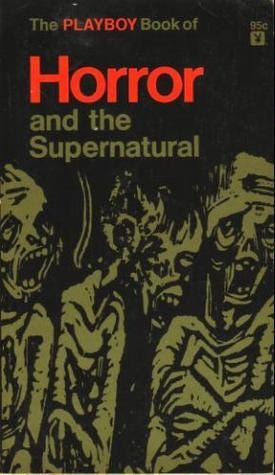
This is not a criticism of the collection; the writing is mostly excellent and there is certainly room in the genre for a more bloodless but biting variety. The book opens with a selection from John Collier, a master of wickedly witty tales of crime and horror. Collier is one of my favorite authors and I can’t fault any editor who holds him up as the guiding light of their curation.
Among the stories originally published in the pages of Playboy and included in the anthology is Ray Russell’s Sardonicus, from the January, 1961 issue. Its presence is not surprising, since Russell worked as a fiction editor for Playboy and actually edited this volume. He even gets a second piece in the collection.
Ray Russell was not a particularly prolific writer, publishing only 14 novels in his career, but he also worked as a screenwriter, writing several scripts for Roger Corman in the 1960s: Premature Burial, a Poe picture, and the excellent X: The Man With X-Ray Eyes, as well as the adaptation of his own story from this collection.
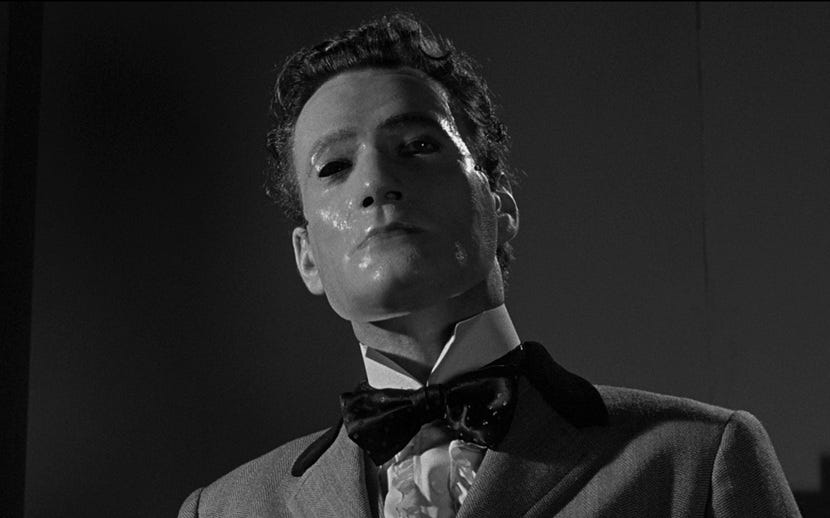
Sardonicus, written in an old-fashioned sytle, begins in 1880 with an English surgeon receiving a letter from an old flame inviting him to visit her in her remote estate in Bohemia. Intrigued, he travels there to find that she has married a nobleman named Sardonicus. He quickly discovers that he was invited not to re-kindle his relationship with her but to treat her husband, who is disfigured with a horrifying facial rictus that pulls his lips away from his teeth.
He reluctantly agrees but draws the line when Sardonicus insists on a therapy involving a potent South American poison that relaxes the muscles. Sardonicus threatens to force his wife to have sex with him if the doctor doesn’t agree. The doctor agrees and the treatment is a success, removing the rictus from Sardonicus’ face. As a reward, the Baron annuls his marriage and sends the doctor away with his old flame.
The newly married pair find out later that the Baron has died, as the treatment left him unable to open his mouth and he died of thirst and starvation. The doctor reveals to his new wife that he never used the poison, only distilled water because he was convinced that the condition was psychological, the result of a horrifying incident where Sardonicus dug up the corpse of his father to retrieve a winning lottery ticket only to discover his father’s corpse disfigured with a rictus grin.
Cue the Twilight Zone music.
While the events of Sardonicus are slightly more distasteful than the other stories in the volume, it is right on target with its ironic ending.
Sardonicus was almost immediately turned into a movie, Mr. Sardonicus. This was a fairly faithful transfer of the story, directed by schlockmeister William Castle. Castle was famed for his promotional gimmicks, such as putting buzzers under theater seats for The Tingler and flying plastic skeletons over audiences for The House on Haunted Hill. For Mr. Sardonicus, the gimmick was a ‘Punishment Poll,” where, allegedly, audiences could pick whether the villain was punished at the end of the movie or allowed to get away with their crimes. No evidence exists that Castle actually shot the lenient version, all prints end with Sardonicus’s ironic fatal fate.
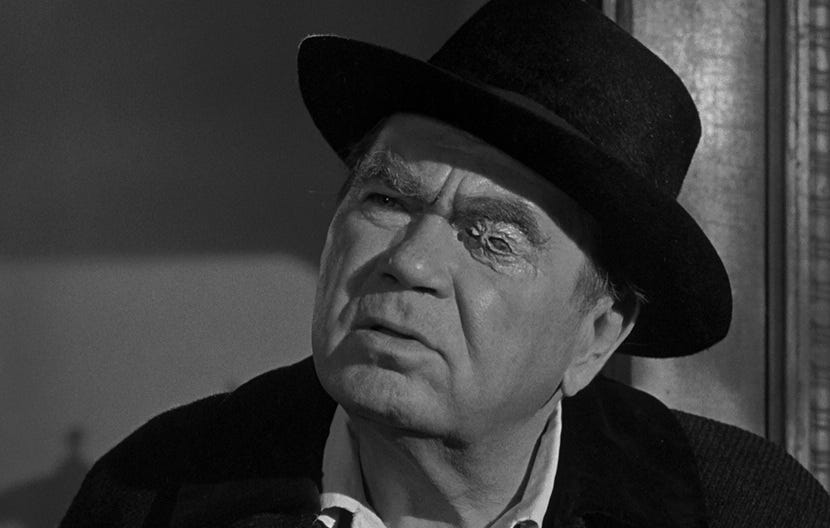
In spite of the gimmicks and Castle’s annoying presence, Mr. Sardonicus is a fine little horror movie. Most of Castles horror movies, gimmicks aside, were competently made, some with a few genuinely creepy moments. It features plenty of foggy sets and solid acting, especially Guy Rolfe as Sardonicus. A side plot involving Sardonicus torturing beautiful young girls is thrown in, probably at Castle’s insistence. One improvement, however, is the presence of Oskar Homolka as Sardonicus’ loyal servant, Krull. With a disfigured eye and his Eastern European growl, he makes the perfect henchman.
I enjoyed Sardonicus so much that I will be seeking out more of Russell’s work. I realized, while researching this post, that I read his novel Incubus back in the day. I remember it made quite an impression on me, how could it not, it’s about a demon who uses his giant penis to attack women. Yeah. Regardless, I hope his other work is as well crafted as Sardonicus but not as over the line as that.
I strongly recommend The Playboy Book of Horror and the Supernatural, however. It’s long out of print but available on Amazon and Ebay. It’s the perfect book to read in the evening with a martini and a little jazz in the background. Bearskin rug optional.
Jazz and horror sounds like a tailor-made slice of bliss. Martinis optional, but certainly not out of the question. I haven't made those in ages and I was always the man hauled in at parties to make 'em.
Loved watching this on a long gone Sony portable TV.