
Rififi
Brilliance and nihilism
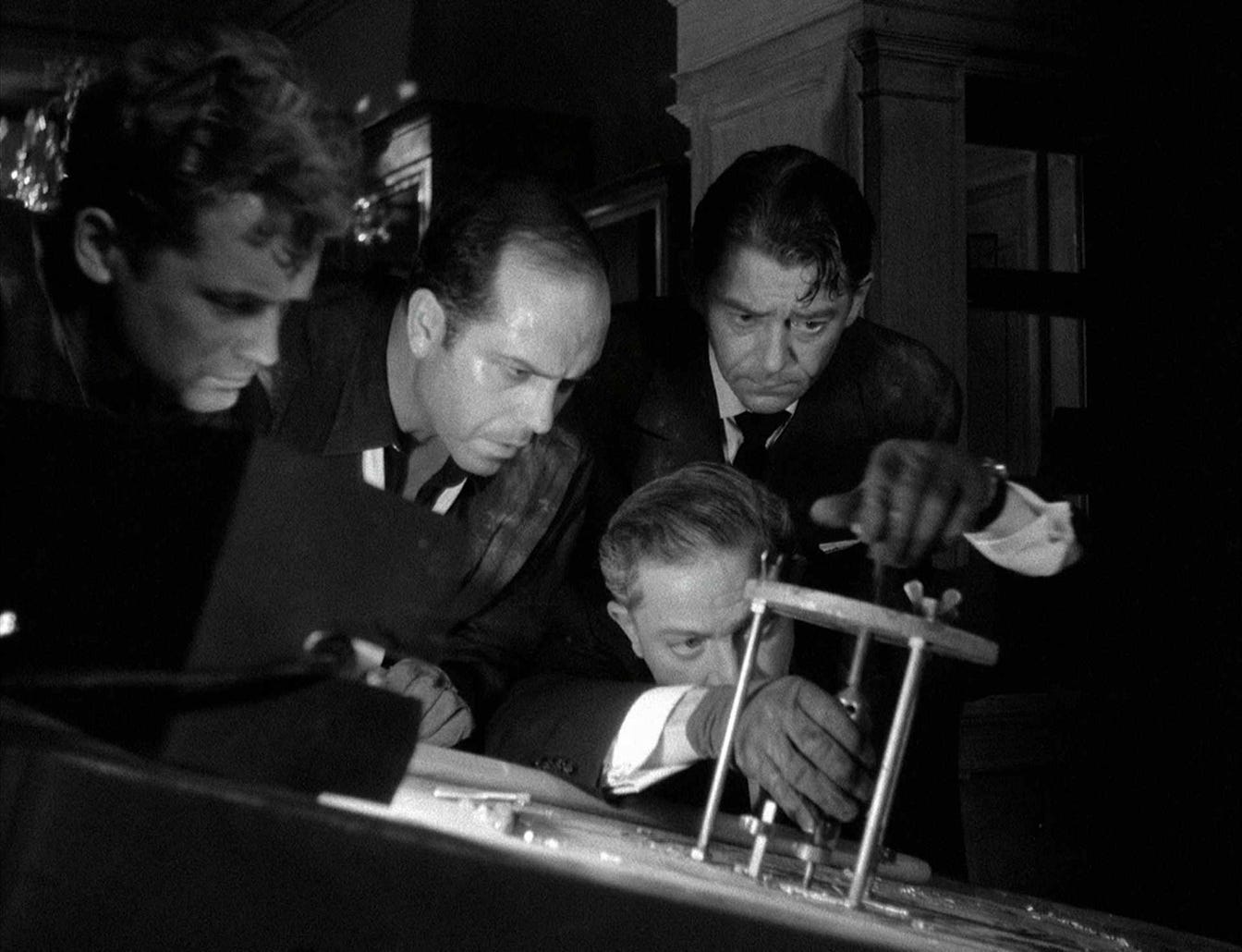
According to a singer in the film, Rififi is French slang for ‘rough and tumble’ which is either a metaphor for intercourse or the thug life.
Either way, Jules Dassin’s heist masterpiece Rififi is a smoothly executed film drenched in realist style, set in the shadowy French underworld.
Tony le Stéphanois (played with dour intensity by Jean Servais) gets out of prison and falls into the orbit of his old gang, Jo and Mario. Mario wants to do a smash and grab at Paris’ most elegant jewelry store; initially Tony demurs. He is too focused on his old girlfriend, who took up with a tough strip club owner after he went up the river. He manages to get over her by stripping her naked and beating her with a belt (!!) which frees him up for the jewelry heist.
Rather than a smash and grab, he proposes breaking in at night and going for the safe. The group is rounded out by safe-cracker Cesar, played by director Dassin. There is a brief planning sequence where they solve the problem of the alarms but the middle of the movie is taken up by a wordless, intricate half-hour heist sequence that manages to be both fascinating and tense.
The heist goes off successfully, even though their getaway is nearly derailed by a few nosy policemen. The haul is enormous and they have arranged a hand-off to a London fence.
Then, of course, everything goes wrong.
I won’t spoil the final act, except to say that The Betrayal trope rears its ugly head, in this case not a deliberate betrayal but a selfish act by one of the team members that exposes them to the strip club owner’s gang of thugs. Dassin, one of the great Film Noir auteurs, delivers a classic, grim Noir ending.
Rififi closely follows the template set by The Asphalt Jungle (reviewed last week) a few years earlier. Supposedly, the author of the novel Rififi was based on set out to copy that film’s success. As a result, it doesn’t create any new innovations in the form but sets a high bar in the form of the detailed robbery.
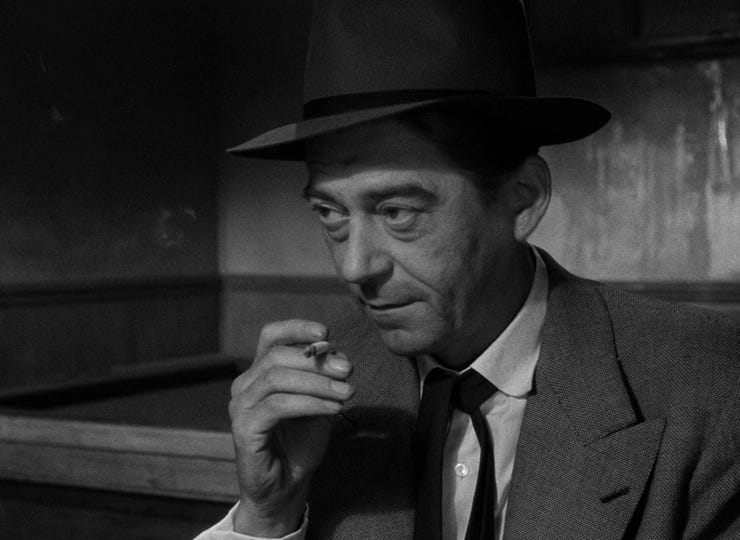
The character of Tony is harsh and nearly unlikable. His abuse of his girlfriend is shocking and the movie never provides any justification for it other than she took up with another man after he went to jail for five years. He rarely smiles. The other gang members share humanizing qualities: Jo is a good husband and doting father, Mario is gregarious and sweet to his girlfriend, safe-cracker Cesar is a skirt chaser who falls under the spell of the strip club singer.
One of the most revealing moments of the film shows the gang sitting around the suitcase of money, millions of francs, that they received in exchange for the jewels. One by one, they relate what they plan to do with their share. Mario wants to take his girlfriend on a tour of Europe’s finest hotels, Jo plans to put it towards his son’s education, Cesar intends to spoil the singer. When it comes to Tony’s turn, he just shrugs. He has no need or plan for the money, no life to enhance, no wife or girlfriend to share it with. As the film opens with him going bust in a poker game, you can easily imagine him gambling it all away.
He’s an empty man, with nothing to fill his soul.
The films masterfully filmed tense and desperate ending provides Tony a measure of redemption, but it’s a hollow victory since everyone is dead and the money is lost.
Dassin was making films in France because he was a victim of the Hollywood blacklist. After completing Thieves’ Highway (reviewed HERE), his third hit crime film in a row, he was warned by Darryl Zanuck, head of 20th Century Fox, that he was due to be hauled before the House Un-American Activities Committee and asked to name names. Zanuck assigned him to direct Night and the City in London, which got him out of the country.
While he stayed away from the U.S. long enough to avoid testifying, the long arm of the blacklist kept him from several European directing jobs, including one where a red-baiting American labor leader threatened the movie’s star and producer, Zsa Zsa Gabor if she didn’t withdraw. The State Department actually got him thrown out of Italy.
Rififi is Dassin’s indictment of the Blacklist, whether he meant it to be or not. The character he plays is an informer who pays the ultimate price for their betrayal. Since he co-wrote the script, you have to assume that was not a coincidence. But beyond that, it’s sheer brilliance is a reminder of what was lost to cinema because the powers that be in America chose to purge any artist that strayed too far from the political center. (To the left, that is) Other blacklisted writers and directors never got the opportunity to show what they could have contributed while they were in exile. Some never recovered from the Blacklist at all.
Noir godfather Eddie Muller considers Rififi to be the greatest heist film of all time. I’m going to wait to render my verdict until I’ve watched a few more of the classics. But Rififi is magnificent.