
Punishment Park
Raw political film-making
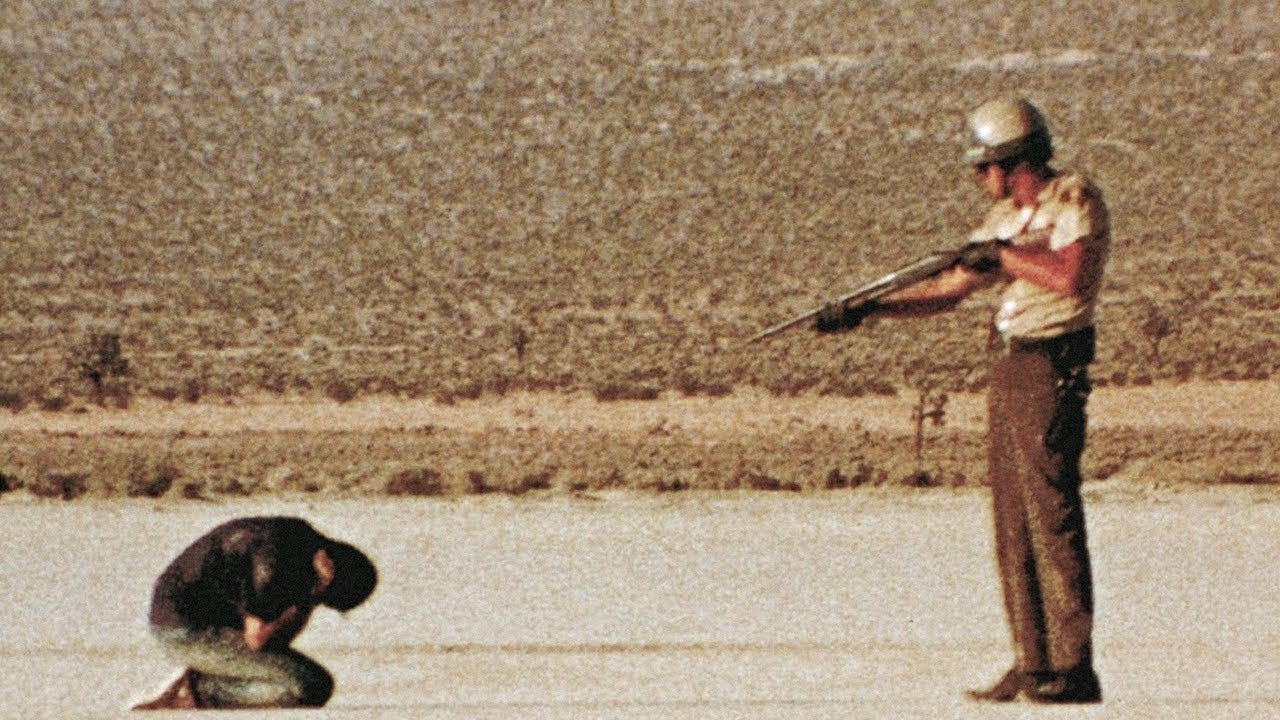
I have previously talked about the recently passed filmmaker Peter Watkins (HERE) and his politically dramatic movies. He was a strong voice at important political moments in the 1960s and 1970s. His grim and shocking anti-nuclear film The War Game, produced by the BBC was banned by the government and not shown on television. There is no questioning that we here in America are living through an equally important political moment; one of Watkins’ films from a similar time is equally confrontational but shockingly relevant today.
Punishment Park was released in 1971, a fraught period in American history. President Nixon had, secretly at first, then openly, escalated the Vietnam War by sending troops into Cambodia and bombing North Vietnam. This is after running and promising to wind the war down. This intensified anti-war efforts at home, especially after the New York Times published the Pentagon Papers, which showed that President Johnson had lied to get the U.S. more deeply involved in the war.
The movie is an alternative history that takes off from this point. The war is escalating, with the real risk that China is going to enter on the side of North Vietnam. President Nixon invokes the McCarren Act, which allows him to arrest anyone who advocates revolution or resistance to the war effort or merely expresses ideas considered subversive. Large numbers of anti-war activists are arrested, along with young men who merely resist the draft. Nixon has also tripled the number of men subject to the draft.
The accused are transported to a camp in the middle of the California desert called Punishment Park. There, they face a tribunal that quickly finds them guilty and sentences them to lengthy prison sentences. Each of them is give the choice to serve the sentence or to run a course in the desert with a chance of going free. They are given three days to reach a U.S. flag on a mountain 53 miles away.
(Spoilers) The film is done found-footage style, with a European film crew following both the runners and the pursuers. The movie bounces back and forth between a group on the run and a new group undergoing trial. The runners are given a two hour head start before a select group of LAPD swat team members and military begin to hunt them down. Meanwhile, we see several of the accused verbally battling with the members of the tribunal.
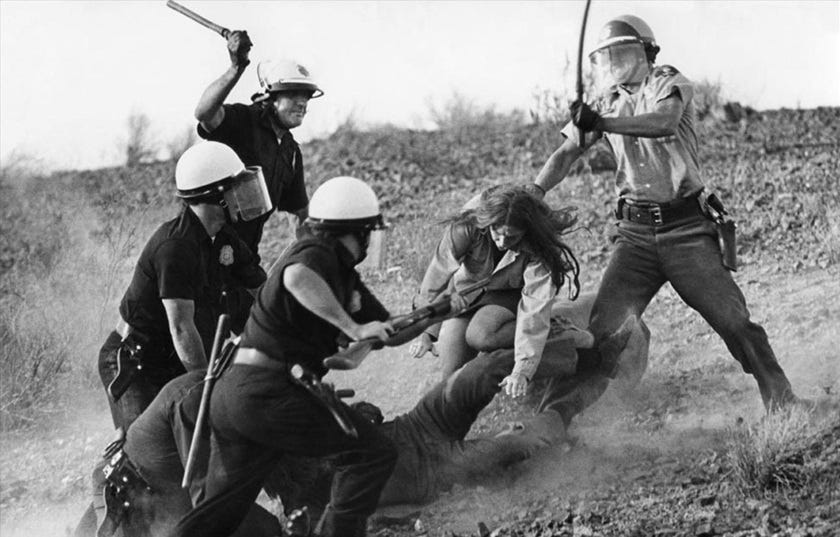
Several members of the runners ambush a squad car and kill the cops, stealing their car and guns. This enrages the rest of the pursuers, who are shown discussing the deadly effects of their weapons. One by one, they catch up with the runners and gun them down. This includes a handful that actually make it all the way to the end. It’s not clear whether this is a result of the cop killings or an inherent element of the whole scheme.
Watkins uses his usual bag of tricks: hand-held cameras, you-are-there cinema verite, improvisation, and non-professional actors. This lends an air of authenticity to the proceedings. The actors who perform as the tribunal seem like they were actual right-wing Nixon voters who believe the lines they spew at the dissidents. You have several types who ring true to the right-wingers of that day and still persist to the present: the moralistic housewife, the red-baiting Senator, the union leader who hates hippies, the arrogant college professor who scorns the arguments of the resistors.
The only weak point of the film is the speeches from the accused that go on too long and can seem a little dated. But the rest of the film that takes place out in the desert is a searing, stripped down depiction of police brutality and state-sanctioned murder. The cops seem like real cops, with the sort of bloodthirsty callousness that was common at the time and has resurfaced again and again since then.
Punishment Park was harshly criticized on its release and its distributor buried it. The main complaint was that Watkins went overboard The New Yorker said: “No one voices an original though in this offensive futuristic fantasy that depicts the U.S. as a totally fascist state solely inhabited by bigoted pigs - Left and Right.” The New York Times: “Peter Watkins’ ‘Punishment Park’ is a movie of such blunt, wrong-headed sincerity that you’re likely to sit through the first 10 hysterical minutes of it before realizing that it is, essentially, the wish-fulfilling dream of a masochist.” The movie was shelved and never shown on television.
I watched Punishment Park just a few days after the killing of Alex Pretti in Minneapolis. It really resonated with me. Critics of the film in 1971 seemed to think it was a gross exaggeration that the American government and law enforcement would round up dissidents and murder them. This despite the 1968 Chicago Democratic Convention, Nixon’s Enemies List, and Kent State. I don’t think any reasonable person could watch footage of how ICE is brutalizing immigrants and protesters and think that this wasn’t the result of deliberate policy. I don’t see how the building of a massive database of Americans who express dissent and labeling them ‘Domestic Terrorists’ isn’t going to lead to a dark place.
In troubled times, art should lead the way in shining a light on oppression and even go as far as to incite audiences to action. Sometimes you want comfort food and sometimes you want ghost pepper hot sauce. Sometimes you need soothing muzak, sometimes you need punk rock. No one should ever have to apologize for making art that goes hard.
Punishment Park is available to stream free on Tubi.
(Thanks to Trailers from Hell for bringing this film to my notice.)