
Laura
Mis-labeled as Noir?
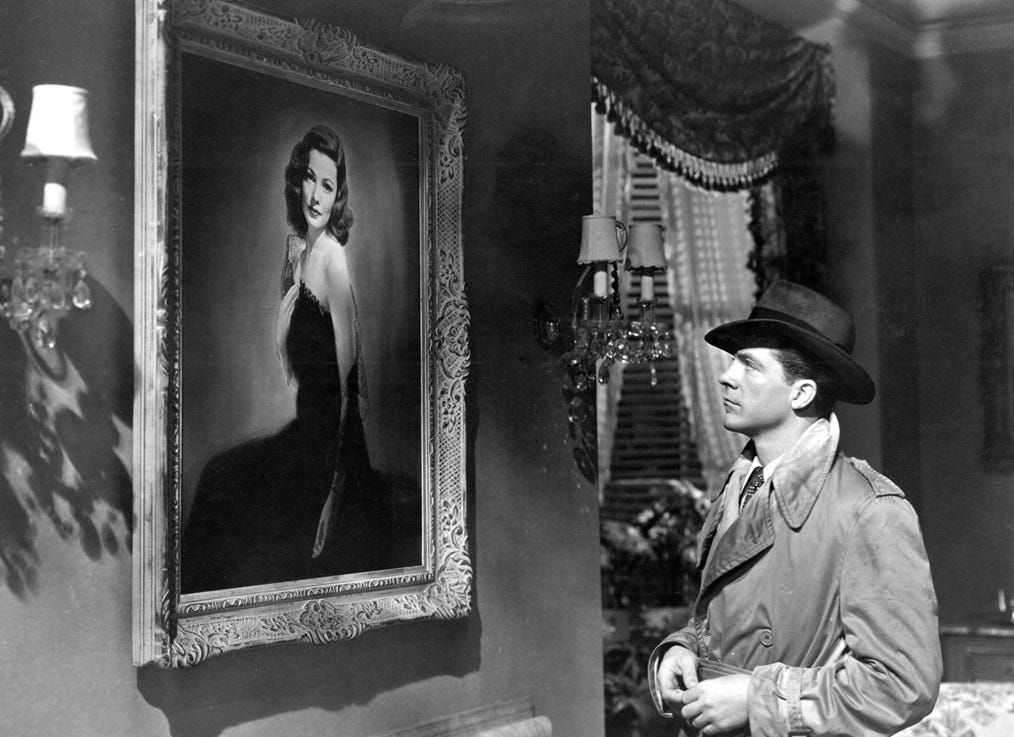
If there was a year when the genre of Film Noir was really born it was 1944. That was the year of Edward G. Robinson’s and Fritz Lang’s dark Woman in the Window, Dick Powell’s turn as Phillip Marlowe in Murder My Sweet, and the hugely successful and influential Double Indemnity.
And Otto Preminger’s Laura.
But was Laura truly a Film Noir?
(spoilers) Laura Hunt (Gene Tierney), a successful New York advertising executive, is introduced postmortem by gossip columnist Waldo Lydecker (Clifton Webb), in the immediate aftermath of her murder. She is described and lionized by friends, her maid, her fiance, and Lydecker himself. Then the story shifts to flashbacks and we see how Laura climbed the corporate ladder through bold action, charm, and determination.
Police detective Mark McPherson (Dana Andrews) works the case, developing a sense of admiration for Laura along the way. It’s clear that her fiance Shelby Carpenter (Vincent Price) was unworthy of her and he becomes the primary suspect in her death.
Then, in a one of the great plot twists of all time, Laura walks into her apartment, alive and well. It turns out that the woman found in her apartment, wearing her negligee, with her face blown off, was a lover of her fiance who was cheating with him in her bed. McPherson still has a murder to solve, as well as to try and unfold the puzzle of Laura herself. As he does so, his admiration blossoms into love.
I won’t spoil the ending other than to say it makes sense and is tensely staged.
As the film was in production, Caspary explained her unhappiness with the adaptation. She lamented that Preminger “wanted to make it a conventional detective story; I saw it as a psychological drama about people involved in a murder.” She complained to Preminger “...how you’ve dulled the characters, especially Laura.”
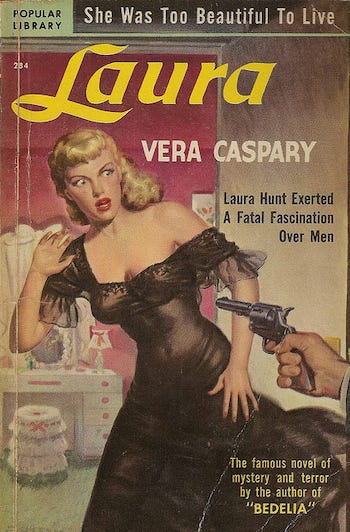
I agree. In the book, McPherson is a much more interesting character. He is a jaded cop, but also an intelligent and somewhat educated person. He doesn’t quite fit into the glamorous Manhattan social scene, but he’s no knuckle dragging ape. And Laura could serve as the archetype of the postwar modern, professional woman. But as Gene Tierney plays her, she’s a bit of passive ding bat at times, ready to fall into the arms of just about any man who’s halfway nice to her.
I defined the development of Film Noir: Film Noir developed as a result of largely left-wing filmmakers attempting to adapt hard-boiled fiction during the 1940s and early 1950s, while restricted by the Hollywood Production Code and B-movie budgets. Laura certainly fits the profile of left-wing creators. Preminger was not noted for political activism, but many of his films challenged social taboos and he was one of the first directors to break the Hollywood blacklist. Laura author Vera Caspary was involved with Communism in the 1930s and was later grey-listed during the Red Scare.
The crucial element missing from Laura is adaptation of hard-boiled fiction. The previously mentioned Double Indemnity, The Woman in the Window, and Murder My Sweet were all hard-boiled adaptations. Laura the book was either a romantic thriller or a murder mystery. The movie has a happy ending, with McPherson landing Laura and moving off into happily ever after land. The whole thing takes place in the brightly lit world of Manhattan’s upper social tier. It in no way resembles a tough-minded book like Double Indemnity or The Glass Key.
Not all Film Noir was adapted from hard-boiled fiction, however. Some films of the genre were a savvy blend of the “woman’s picture,” melodramas aimed primarily at a female audience, and the crime film. I’ve spoken previously about how smart Golden Age Hollywood was in crafting movies that appealed to both men and women. It’s no accident that just about every Film Noir featured women in prominent roles – the dreaded Femme Fatale, for instance – and some even featured them as protagonists. In a film like Laura, you get a dynamic, modern woman but also the old-school tough gumshoe in the character of McPherson. There’s romance, but also murder. And some hints of sex.
I don’t want to be a gatekeeper for what and what isn’t Film Noir. But I did come up with a definition of its development that is somewhat exclusionary. I do think that some critics and reviewers are either a little too careless with the term or tend to promote shallow tropes like shadowy cinematography or guys in fedoras and trench coats or sexy women in tightly tailored gowns. The term Femme Fatale gets abused frequently; some label Laura as one. She absolutely is not.
Laura is a great movie. It was an influential film that led to similar films that were clearly Noirs, even by my definition. But Vera Caspary was right, it’s “a conventional detective story,” with flat characters.
But by all means, please watch it if you haven’t.
I love the film Laura. I think Lydecker had the best lines. Despite being a heel, he's pretty damn funny. Well, what am I saying? Lots of heels are funny. I thought that a film noir had to show the protagonist being worse off at the end than in the beginning. I'm not sure who made this rule, but it certainly fits with many. Double Indemnity and Detour and so many others but it's hard to say for sure. Great post, Patrick.