
E. F. Benson
The other British master of the ghost story
I was able to catch the latest installment of the BBC’s A Ghost Story for Christmas over the weekend, last year’s adaptation of E. F. Benson’s The Room in the Tower. It’s okay, it adds an unnecessary framing device, but is otherwise true to the story. I wouldn’t rank it among the series best adaptations.
It did get me thinking about Mr. Benson. The series has most often adapted the acknowledged master of the ghost story: M. R. James – 12 so far. This is their first, and I hope not the last, adaptation of a Benson story.
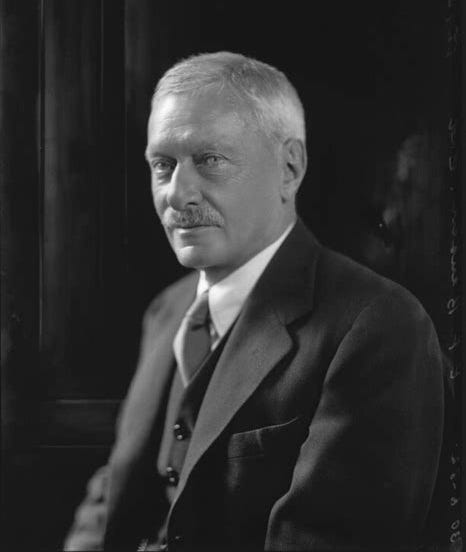
Benson was the son of a school headmaster; two of his brothers were also authors of ghost stories, but were not quite as successful. Of the three E. F. had the most overall literary success, especially with his non-ghostly Mapp and Lucia series. In his lifetime, Benson published four volumes of weird stories: The Room in the Tower, and Other Stories; Visible and Invisible; Spook Stories; and More Spook Stories.
Personally, I think E. R. Benson ranks up there with James. Like the master, he usually includes a physical element to his ghost stories, often something rather grisly. I love a ghost story that adds a rotting skeleton, repulsive thing, or a hidden reminder of tragedy that grounds the tale and brings the spectral into horrifying detail. Some of his tales involve no ghost but are weird tales involving various strange and malignant forces.
Benson eschews James’ bachelor scholars digging into the past. Some of his horrors are rooted in ancient crimes or are revenants from beyond the grave, but he writes firmly in the present and his characters are solidly modern. With James, the protagonists go seeking lost knowledge and in doing so, they intrude where they should not be. With Benson, the victims of the forces of evil merely are in the wrong place at the wrong time and rarely initiate their fates (with one notable exception below).
If I have any criticism of Benson it’s that he often telegraphs his horrors. His payoffs usually excuse this.
Here are a few of my personal favorites of Benson:
In Caterpillars, a man receives a vision of a horde of hideous caterpillars crawling across a bed. The next day, a friend shows him a living sample of the same that he found on his window sill. He squashes it underfoot and dismisses it with a laugh but it turns out that they have a deadly and sinister purpose.
The Bus Conductor. A man is haunted by visions of a hearse driver stopping to tip his hat and call out:“‘Just room for one inside, sir,” Eventually, he has a near brush with death that makes it clear that he was experiencing chilling pre-cognition. The story was adapted as part of the pioneering horror film anthology Dead of Night in 1945. Elements of the story were also ‘borrowed’ by Rod Serling for The Twilight Zone in the episode A Stop at Willoughby. If you want to learn more about Serling’s ‘borrowing’ habits, check out my previous post (HERE).
The Face. Like The Room in the Tower, the protagonist is haunted by a recurring dream. Here, there is no last minute reprieve.
Negotium Perambulan is my personal favorite Benson story. Here, a remote West Cornwall village church is haunted by...something. A panel of an altar rail recovered from a more ancient chapel includes a carving of a priest warding off the thing with a legend that states: “Negotium perambulans in tenebris.” Translated, the line readss: “the pestilence that walketh in the darkness.” It’s a classic of physical horror.
The Man Who Went Too Far may well be Benson’s masterpiece, however. Frank Halton, a one-time artist, finds rejuvenation in an ancient wood in the countryside. He gains youth in his appearance and spirit by communing with nature in the wilds shunned by the locals. While doing so, he hears spectral pipes playing somewhere off in the trees. For most of the story, he regales his friend Darcy with the wonders his re-connection to nature has rendered, but in the end, the darkness of the woods comes to claim him.
Benson was a closeted gay man; it’s easy to read The Man Who Went Too Far as a parable for his own repressed sexuality, complete with the tragic punishment for a man who indulged in the forbidden. Either way, it’s a beautifully written story.
This tale is included in my own collection of classic ghost stories: Gothic Haunts, available here.
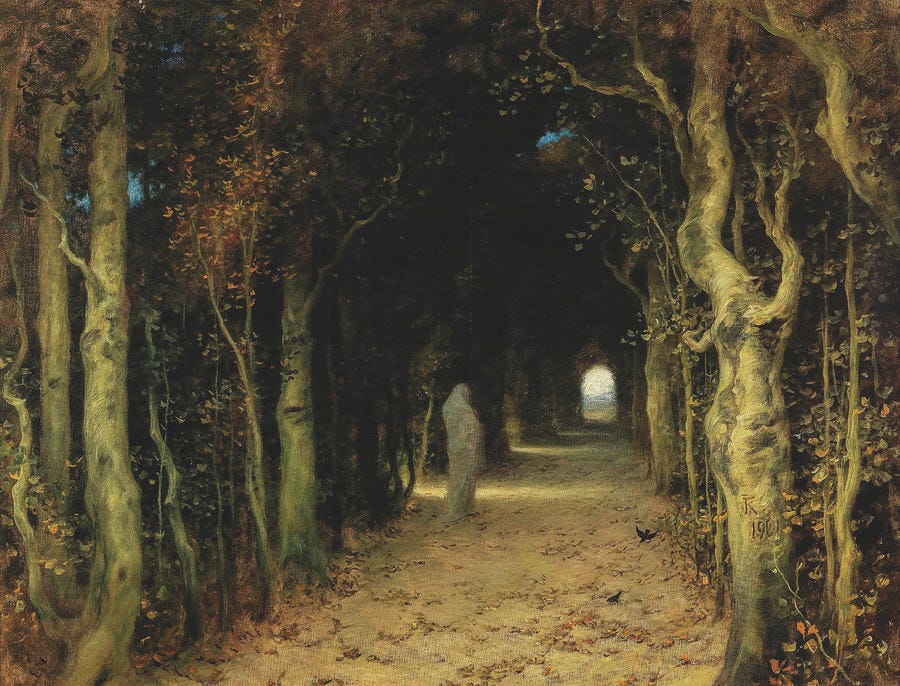
Illustration: Lady Absinth, Ferdinand Keller
My favourite is one called "tale of an empty house". It's just so evocative in it's descriptions and downright creepy!
These all sound great!