
Daddy’s Head
Horror and metaphor
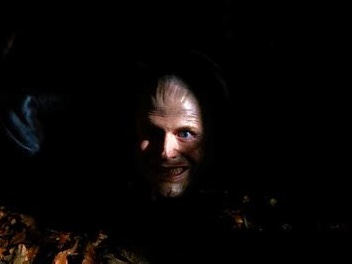
Fans of crime fiction, please pardon me while I interrupt my normal schedule of posting crime takes on Wednesdays to add one more post for the spooky season.
Those of you familiar with my Substack know I love to highlight overlooked and neglected films. This extends to the Horror genre as well as Crime, which is why I’m presenting Daddy’s Head today.
Daddy’s Head opens with young Isaac visiting his father James in the hospital, who was seriously injured in a car wreck. Isaac already lost his mother and when his father dies, he is left to live in their house in the woods with his new stepmother, Laura. Unfortunately, Laura does not measure up as an adoptive parent, as she is submerged in her own grief and had never established much of a relationship with Isaac before her husband’s death. It doesn’t help that Isaac is channeling his grief into violent and disruptive behavior.
Laura soon begins to see strange visions outside the house and in the woods, visions of her dead husband. Isaac, too, is visited by a strange creature that has assumed the face of his father. The already dysfunctional household is under assault by these strange forces; the family dog is killed by something in the forest and James’ grave has been vandalized. A family friend, Robert, steps in to try and help both Isaac and Laura, but he too is attacked by whatever lurks in the woods.
The movie builds tension to the point where Laura has to step in to protect Isaac from the strange creature; she succeeds in injuring it and driving it away. The film closes with a time jump forward, where an older Isaac returns to confirm the threat is ended and it’s clear that he and Laura have found an a way to relate to one another.
I’ve said previously that great horror movies are about something, that they include themes expressed through the characters and settings that build a deeper emotional connection with the viewer. Daddy’s Head certainly meets that criteria as it is built around a framework of grief, with the two main characters struggling to cope with loss, and lacking the support system to aid them in processing it. The viewer can empathize with both Laura and Isaac, as both of them are disabled by their grief. The fact that the unnatural being that threatens them takes on the appearance of James only makes the situation more painful and terrifying.
In the case of Daddy’s Head, the source of the trauma is present right from the beginning. The whole framework of the movie is established as dysfunctional from the start. Therefore, the metaphor is present immediately. I think this is essential to any horror movie that aims to use metaphor in its execution.
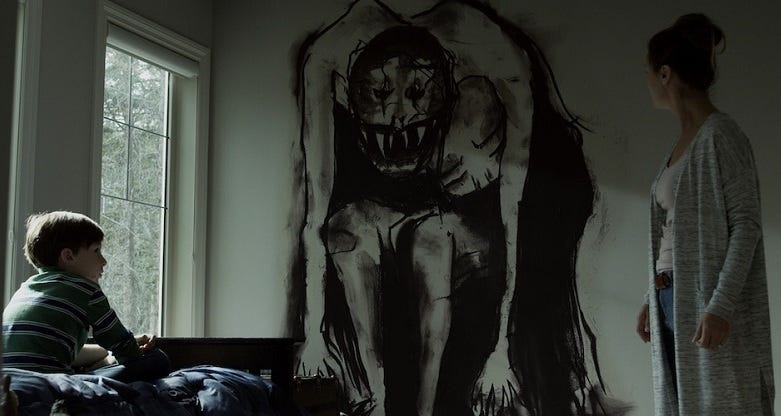
I contrast this successful effort at metaphor with one less successful: the Canadian horror movie Z. Once again, you have a disturbed child, Joshua, who is expelled from school for anti-social behavior. He has an imaginary friend he calls Z, which appears to be exerting a malign influence on him. His mother eventually is able to see the monstrous “friend” but is powerless to drive them away from Joshua. Watching a tape from her childhood, she realizes that Z was her imaginary friend, as well. Further revelations of family trauma emerge and her attempts to fight the entity end tragically.
Z is a solid movie with some genuinely shocking jump scares (I yelled out “Oh My God!” at one of them), but it lacks the resonance of Daddy’s Head, or the much better movie it closely resembles: The Babadook. I think this is due to the fact that the trauma that underlies the story is not present from the beginning. Z opens in near-full normality; in both Daddy’s Head and The Babadook, the underlying dysfunction and pain of the characters is inherent in the story. The ‘secrets’ in Z unspool slowly, which dilutes their impact, I think.
This isn’t a bad storytelling structure, plenty of terrific horror movies are build on revelations. I give you another example: Hereditary. One of the greatest horror movies of all time, Hereditary also relies on shocking revelations late in the story. But it also starts out as a portrait of a deeply dysfunctional family with a mother who clearly has some serious issues. The seriously flawed family dynamic in this movie is essential to all the events that unfold and when the wild ending unfolds, it spirals out of this chaos.
Aside from its skilled use of metaphor, Daddy’s Head is an atmospheric, creepy film with several excellent jump scares. My view of it may have been colored by the fact that I watched it in the dark in a thunderstorm. Maybe that’s how we should watch all horror movies.